Unlock your business’s potential with MRB Media’s expert SEO-driven marketing and web design strategies. Book a consultation to start your journey to online success today!
Follow Us Anywhere!
©2024 MRB Media, Inc. | All rights reserved.


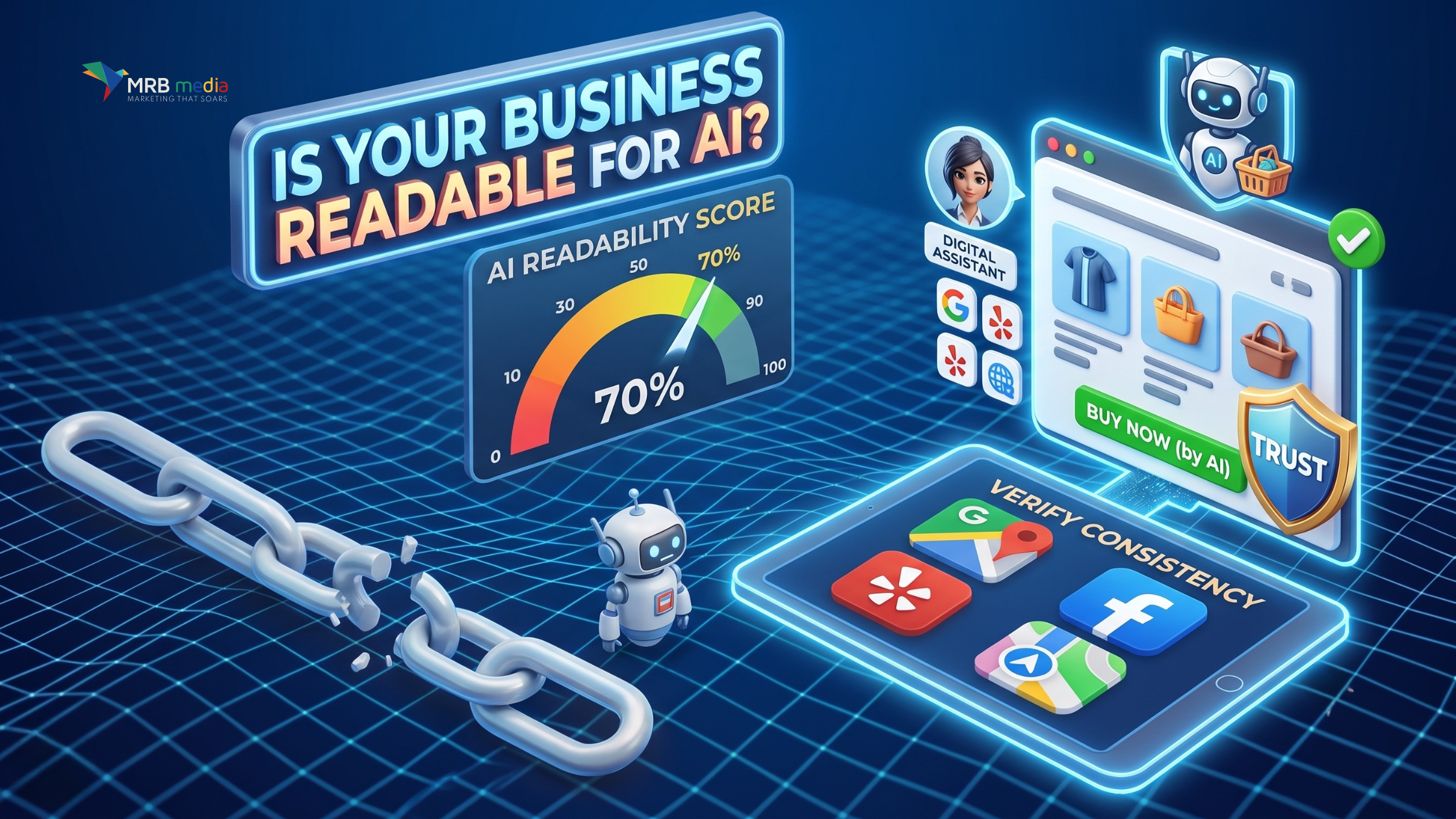
It sounds like science fiction, but it is already happening. A recent Braze report found that 14% of consumers currently use AI agents to search and buy things on their behalf. That number is on track to more than double by the end of the year as major tech companies push these assistants into the mainstream. At the same time, Google is rapidly expanding its automated AI booking features for local services. Your world just changed.
For business owners, the lesson is clear. You now have two separate customers to impress: the human buyer and their digital assistant. This is called agentic search. If an AI assistant cannot read, verify, or trust your online business details, your company will not even show up on the recommendation list. The robot shopper will simply ignore you and choose a competitor instead.
The shift is happening fast. Shopify recently reported that AI-driven traffic on its e-commerce network grew an incredible eight times year-over-year in early 2026. Even more shocking, orders originating from AI-powered searches jumped nearly thirteen times over that same short period. We are not talking about a small, experimental trend. As shoppers offload their research to virtual assistants, the classic digital sales funnel is being collapsed into a single conversational turn.
Robot shoppers behave differently than humans. Humans browse, click through homepages, compare tabs, and get distracted. AI assistants perform all that boring filtering, window-shopping, and comparison work in the background before they ever send the user to a store. This explains why 55% of AI-referred shoppers land directly on a specific product page, compared to only 20% for traditional search traffic. The assistant does the hard work.
But there is a major problem. Adobe estimates that between 30% and 40% of high-value page content on top-performing retail websites is completely unreadable to AI web crawlers. If a search bot like ChatGPT or Perplexity scans your site and hits messy code or unorganized product descriptions, it cannot extract the facts it needs. It cannot recommend a product it cannot read. Messy websites are invisible to AI.
Feed the bots clean data. AI assistants are notoriously lazy, which means they prefer to lift clean, direct answers from the very first two or three sentences of your pages. We call this Answer Engine Optimization. There is also the trust factor to consider. If your business name, phone number, and hours match on Google but look slightly different on Facebook or Yelp, the AI gets confused and flags your business as unsafe. Bot-friendly information must be perfectly consistent across the web.
Do not panic. You do not need to be a coding genius or hire an expensive developer to make this work. By setting up a few simple structures on your website and synchronizing your online profiles, you can guarantee that search bots always find accurate data.
Most cheap SEO packages on the market score poorly here. They focus on writing loads of generic content, but you cannot out-publish the AI. Instead, you must build a digital presence that AI assistants are willing to trust and vouch for.
We handle this tech setup for you. Our team will run a complete check of your search and AI presence, update your local maps, and ensure AI search assistants find and trust your brand. Let us prepare your business for takeoff.