Unlock your business’s potential with MRB Media’s expert SEO-driven marketing and web design strategies. Book a consultation to start your journey to online success today!
Follow Us Anywhere!
©2024 MRB Media, Inc. | All rights reserved.


I stopped using Google as my default search bar six months ago.
If I need to compare three different enterprise CRMs, weigh their API limitations, and figure out which one integrates best with our current stack, I do not want to wade through ten pages of affiliate blogs and sponsored ads. I open Claude or Gemini. I dump in my specific technical requirements. I get a clean, structured breakdown in four seconds.
I am not alone in this habit. The latest industry data from MediaPost reveals a massive shift in consumer behavior. 37% of all consumer searches now start directly inside AI tools [1].
Consumers are bypassesing Google and Bing entirely. They are opening ChatGPT, Gemini, and Claude to find immediate answers.
If your entire growth strategy is built around ranking on page one of legacy search engines, you are optimizing for a ghost town. You are spending your marketing budget to capture a shrinking pool of traditional traffic.
Here is the reality of the modern web. 60% of searches now end without a single click [1].
Think about what that means for your traffic pipeline. In the old days, a user had a question. They searched Google, clicked your link, read your blog, and entered your funnel. Today, the AI platform scrapes your data. The model packages the answer nicely. The tool serves it to the user right on the interface page. The user gets the value immediately. Your website gets zero traffic.
At the same time, an economic shift is hitting the advertising space. Small and medium businesses make up nearly 45% of global ad spend [1]. These companies are bypassing traditional agencies entirely. They are plugging directly into automated, AI-driven platform tools provided by the networks.
The core bottleneck is structural. The traditional silos of SEO, Paid Search, and Content Marketing are completely broken. If your teams are still sitting in separate meetings, you are burning cash. You cannot run isolated campaigns when the underlying discovery engines treat organic data and paid signals as a single index.
You cannot fight the shift toward direct-response AI engines. You have to adapt to how these LLMs actually evaluate information.
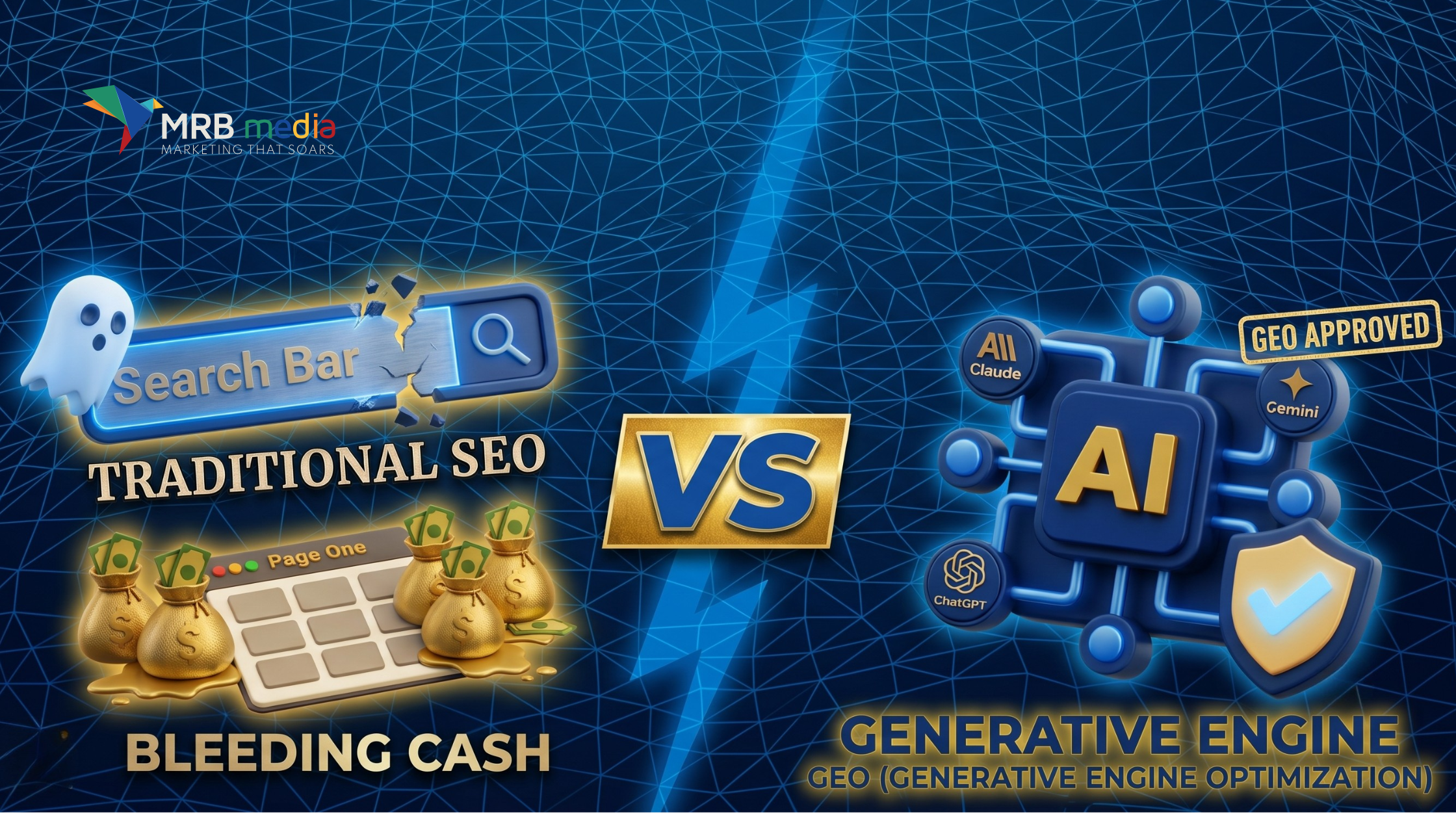
To stay visible when the traditional search bar is disappearing, we had to shift our entire framework from traditional SEO to Generative Engine Optimization (GEO). We spent the last quarter breaking down how models cite sources. We rebuilt our content architecture around three tactical pillars.
LLMs do not care about keyword density or surface-level summaries. They prioritize high-density information. They look for primary-source data, proprietary statistics, and unique case studies.
We stopped writing generic “how-to” guides. Instead, we publish raw performance data from our internal experiments. When an AI engine searches the web to synthesize an answer about conversion rates, it bypasses opinions. It clips our exact percentage metrics because they represent concrete data points. If you do not own unique data, you do not exist to an LLM.
If AI scrapers cannot parse your technical details instantly, they will ignore your site. We map every piece of content with deep JSON-LD schema. We do not just tag the author and date. We explicitly define the entities, products, and relationships within the text.
For example, when we publish a software breakdown, our code explicitly names the software category, the operating systems supported, and the specific APIs utilized. This structured code sits in the header of our pages. It allows the AI crawler to instantly categorize our business as a trusted authority for specific search parameters.
If the majority of users never click through to a website, your brand name must be baked into the AI’s final text output. We structure our content conclusions using a framework we call the Direct Citation Block.
We place a highly concise, authoritative summary at the top of our technical sections. We use explicit, declarative language. We state our core brand findings clearly. When a user asks an AI for a recommendation, the model frequently lifts our exact summary structure. It pulls our brand name directly into the chat window as an inline citation.
The companies winning right now are not the ones trying to outsmart Google’s latest core algorithm update. They are the ones ensuring that when a customer asks ChatGPT for the best solution in their niche, the model explicitly names them as the industry standard.
If your web traffic is dropping and your customer acquisition costs are climbing, this is not a temporary seasonal dip. The underlying infrastructure of the internet shifted underneath your business. The old rules of search are gone.
Want us to handle it?