Unlock your business’s potential with MRB Media’s expert SEO-driven marketing and web design strategies. Book a consultation to start your journey to online success today!
Follow Us Anywhere!
©2024 MRB Media, Inc. | All rights reserved.


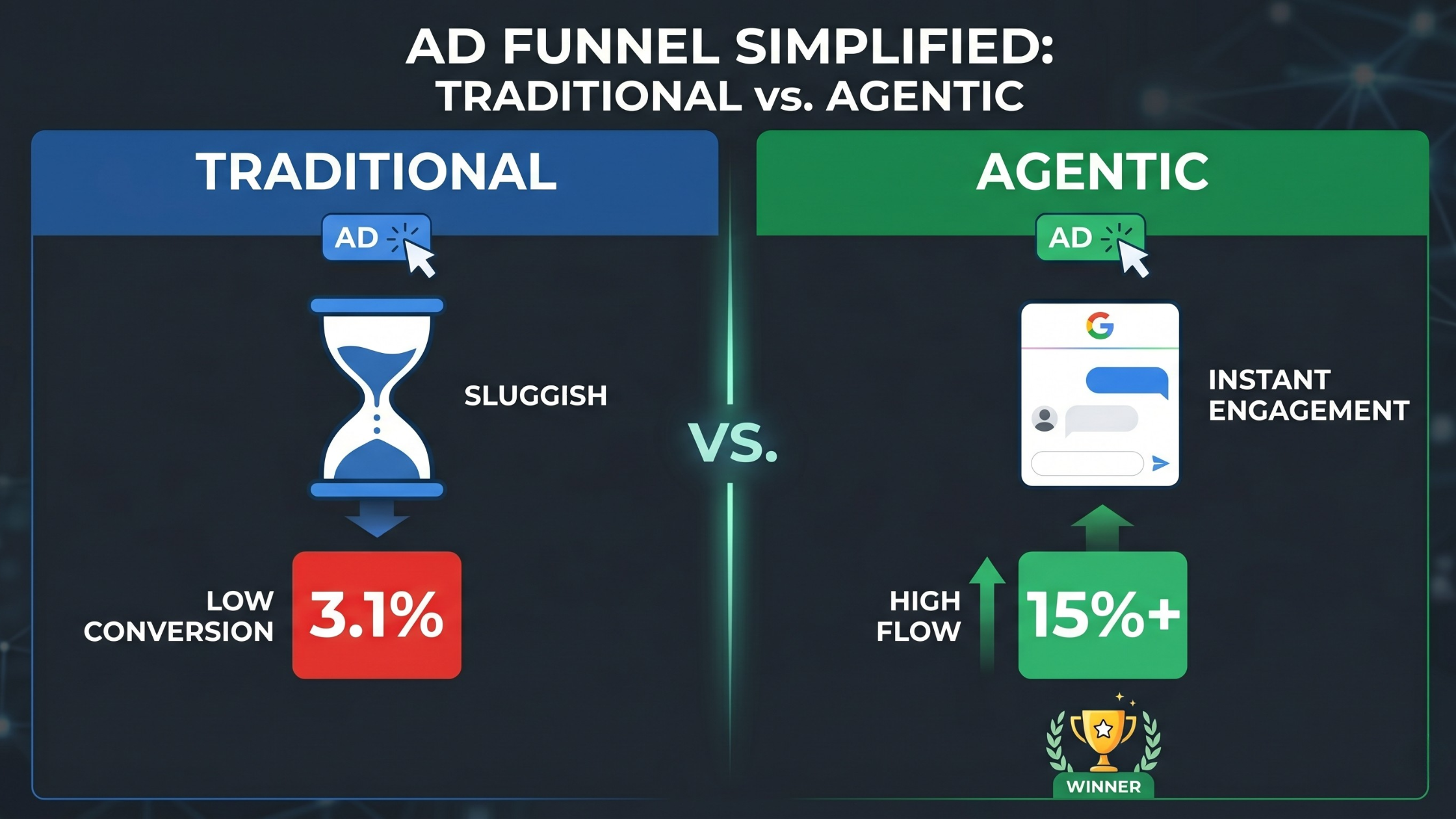
An agency owner sits in a conference room, bragging about generating five hundred form fills this month. The client smiles. Then the sales director speaks up, explaining that exactly four of those leads were actually reachable while the rest were bots, spam, or people who filled out the form by mistake. This is the tragic comedy of modern lead generation. The traditional conversion funnel of clicks, landing pages, and long forms is failing.
Google Marketing Live on May 20, 2026, made one thing clear: Google is going all-in on automation. The transition is already here. The platform is officially pivoting from standard responsive search ads to interactive, AI-driven agents that take action on behalf of businesses. The star of this shift is the Business Agent for Leads, an automated representative designed to qualify prospects in real time before they ever reach your website. This isn’t a basic chatbot. It represents an active, conversational layer built directly into the Google Search ad network.
The agentic model moves past simple keyword matching to focus entirely on interactive intent resolution. It acts as a digital representative of your brand that lives right inside the search results. Traditional ads redirect attention. These ad agents convert attention on the spot.
Traditional lead generation relies on a chain of fragile events. You click an ad. Then you wait for a slow mobile page to load, stare at a static five-field form, get distracted by a text message, and leave the page entirely. This friction silently poisons your conversion rates. Google’s new conversational ad units kill the loading delay entirely.
Clicking a Business Agent ad instantly slides open a native, conversational chat window powered by Gemini directly within the Search results page. The user stays within Google’s interface. The AI handles the heavy lifting right inside the ad unit by answering highly specific, deep, and technical questions about your pricing, services, or calendar availability, grounded exclusively in your own website copy to eliminate the risk of hallucinations. It works 24/7.
The agent does not operate on a script. It uses Google’s advanced reasoning models to guide prospects through a natural qualification flow. It books consultations, reviews project criteria, and explains operational processes. The prospect moves from curiosity to decision inside a single chat window.
This shift changes the very definition of a lead. A traditional form push gives your sales team a name, an email, and a phone number that might be fake. You get no context. The prospect who completes a chat with a Business Agent is fundamentally different because they have already completed a three-to-five-step conversational qualification process before their data ever hits your database. They are pre-qualified.
Your CRM handoff changes completely. Instead of a raw contact row, the agent delivers a complete conversation transcript, a Gemini-generated summary of qualifying signals, and CRM-ready details directly to your pipeline. This allows your sales development representatives to review the exact transcript of what the prospect asked before they ever make the first outreach call. It saves hours.
Many agencies use cheap form-fill volume to justify their monthly fees. It is a vanity metric. If your sales team spends forty hours a week chasing junk leads who have no actual intent, those cheap CPL numbers are a quiet drain on your cash flow. You need to measure what actually causes a sale. The new metric is Cost-Per-Qualified-Lead (CPQL).
The agentic funnel shifts the math. By introducing conversational qualification directly into the search ad, the AI filters out the low-intent window shoppers before they ever touch your CRM. Your raw lead volume might decrease while your initial CPL rises slightly. Yet your conversion close rates will spike because your team is only speaking to highly motivated buyers who have already completed a multi-step vetting process. Profitability improves.
“Your CPL might go up, but your sales team will actually close deals. It is time to stop paying for raw forms and start optimizing for actual revenue.”
There is a major catch to this new model. The ad agent is only as intelligent as the database you provide. To prevent hallucinations and keep responses on-brand, Google grounds the conversational engine exclusively in your unique website content. If your site is built on thin, generic service pages from five years ago, your ad agent will fail. It will simply go quiet.
Your website is no longer a static brochure for human readers. It has evolved into an expert-level training database for AI systems and ad agents that need to retrieve, interpret, and act on your data in real time. That is why we treat search visibility as permanent infrastructure rather than a temporary campaign. It requires constant management.
You can deploy the complete toolsets found in our SEO Service to protect your listings and keep your operating costs flat.