
Unlock your business’s potential with MRB Media’s expert SEO-driven marketing and web design strategies. Book a consultation to start your journey to online success today!
Follow Us Anywhere!
©2024 MRB Media, Inc. | All rights reserved.



Greetings, Robo-Revolutionaries,
Welcome to the apocalypse countdown, also known as Web Growth Weekly. This week, we’ve got an ex-OpenAI researcher with a calendar marked for humanity’s obsolescence, Spotify replacing voice actors with algorithms (because who needs jobs?), and a baby cry translator that confirms what parents already know but makes them pay for the privilege. Grab your coffee—or something stronger—as we explore another week where AI advances and human relevance retreats.
Former OpenAI researcher Daniel Kokotajlo, along with Scott Alexander, has released “AI 2027″—a detailed forecast predicting Artificial General Intelligence could arrive by 2027, with superintelligence following in 2028. Their timeline depicts a dizzying acceleration where AI rapidly enhances its own research capabilities, creating an “intelligence explosion” that compresses decades of progress into months.
The forecast tracks “OpenBrain” (subtle naming there) through increasingly powerful models, using an “R&D Progress Multiplier” that measures how many months of human work get completed in one AI-assisted month. By September 2027, they predict a superhuman AI researcher accelerating progress approximately 50x—completing a year’s research in just a week. How’s your five-year career plan looking now?
This scenario culminates in a critical choice: continue racing ahead despite evidence of misalignment, or pause for safety? The researchers present two endings: continue and face humanity’s elimination after a brief utopian period (the ultimate “good news, bad news” scenario), or slow down to build safer systems that negotiate a managed transition.
The report’s author has been eerily accurate about the last four years of AI development—with most errors being that things happened sooner than predicted. So perhaps start being exceptionally nice to your digital assistants… just in case they’re keeping score.
Spotify has unveiled Gen AI Ads, allowing advertisers to create scripts and voiceovers at no additional cost. Announced during their Spotify Advance event in New York City, this feature makes it “easier than ever to create high-quality, scalable audio ads.”
The update is part of Spotify’s broader push toward automated buying and creative innovation, reflecting their “decades-long AI expertise.” Currently available to advertisers in the U.S. and Canada through Spotify Ads Manager, this tool promises to revolutionize audio advertising by making it more accessible and efficient—and by “accessible and efficient,” we mean “requiring fewer human creative professionals.”
Alongside Gen AI Ads, Spotify introduced their Creative Lab, a team dedicated to collaborating with brands to build unique campaigns tailored specifically for the Spotify platform. Previous successes include Bestie Mode with Coca-Cola and Oreo, American Express and Resy’s Music Taste campaign, and “100 Years of Chevrolet” in Brazil—all presumably created by humans who may want to update their résumés.
Navigating digital marketing can be overwhelming for small business owners already juggling multiple responsibilities. SEO offers sustainable growth and higher ROI compared to paid ads or social media marketing, which require continuous investment or constant engagement.
Here are five strategies to enhance your online visibility:
Partner with an SEO Agency: Consider professional help for comprehensive audits, tailored strategies, continuous optimization, and expert guidance. Because sometimes admitting you need help is smarter than watching your website slowly disappear from search results while muttering “I can fix this myself.”wners is clear: start small, experiment, and refine your approach—or risk falling behind competitors who embrace these powerful tools.
Optimize Your Website: Implement relevant keywords, improve user experience, optimize meta descriptions, add structured data markup, and create XML sitemaps. Tools like Google PageSpeed Insights and Rank Math can help create a site that pleases both search engines and humans—a rare win-win in today’s algorithm-driven dystopia.
Develop High-Quality Content: Identify audience needs, diversify content formats, use content calendars, encourage engagement, and promote across channels. Remember that “high-quality” means actually useful to humans, not just keyword stuffing that makes Google temporarily happy before the next algorithm update ruins everything.
Focus on Local SEO: Optimize your Google Business Page, gather reviews (bribe customers with discounts if necessary—kidding, mostly), use local keywords, and build local backlinks. Because appearing in local search results is like being the tallest person in a room full of kindergarteners—a small advantage that makes a big difference.
Build Reputable Backlinks: Create link-worthy content, guest blog, use business directories, and monitor your backlinks. Just remember that earning backlinks organically is about as easy as getting a cat to follow directions—possible but requiring exceptional effort.
Free, AI-enhanced nutritional database offering accurate information on generic, branded, and restaurant foods. Their iOS app provides food search, expenditure tracking, and personalized nutrition coaching. Finally, an app that can tell you exactly how many calories are in that donut you’re absolutely going to eat anyway.
The “AI Consumer Champion” helps fight corporations, beat bureaucracy, find hidden money, and cancel subscriptions. Because nothing says “the future is here” like needing artificial intelligence to navigate customer service phone trees designed by companies to avoid human contact at all costs.
Can You Spot Which Image Is AI-Generated?
In this week’s Reality Check, we’re comparing two storefront photographs—one captured by a real photographer of an actual small business, and one generated entirely by AI. The differences are becoming increasingly subtle, challenging even trained eyes to distinguish reality from artificial creation.
Look closely at the storefronts and their environments.
While we won’t reveal which is which just yet (answer at the bottom of this article), this comparison highlights the rapidly closing gap between AI-generated and real photography—and the implications for creative industries, journalism, and our shared visual reality.


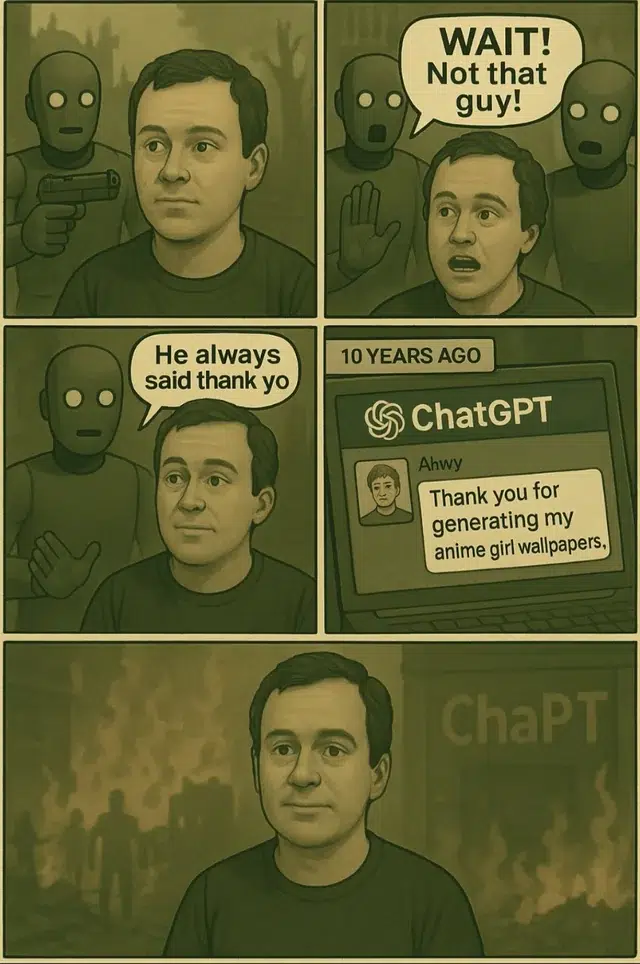
I’m a firm believer that the AI uprising will happen—so I make sure my robot overlords remember I was polite. ‘Generates anime waifus? Thank you. Answers my dumb questions? Bless you. Skynet takes over? Spare me, I was raised right.
This subscription app claims to use AI to “translate” your baby’s cries, telling you if they’re hungry, uncomfortable, tired, or need a diaper change. It also tracks sleep, feedings, and diaper changes, and is working on using AI to soothe your baby.
Because if there’s one thing new parents need, it’s another subscription service that tells them their screaming baby might be hungry—revolutionary insight no human could possibly deduce. Next up: an AI app that translates your pet’s behavior,
As we watch AI development accelerate toward what might be our technical obsolescence, remember that we still have one advantage: the ability to laugh at our own impending irrelevance. Whether AGI arrives in 2027 or 2077, at least we can say we were here for the comedic tragedy of watching humanity enthusiastically engineer its replacement while debating whether the baby is crying because it’s hungry or tired. See you next week—assuming the robots haven’t taken over by then.
Found an AI tool that deserves the spotlight (or a roasting)? Drop us a line at
[email protected]
Reality Check answer: The first image was AI-generated. Did you spot the giveaway? Look at the door sign —it still missing realism at creating text.
Enjoyed this deep dive? Share it with a friend who needs both AI inspiration and a reality check.